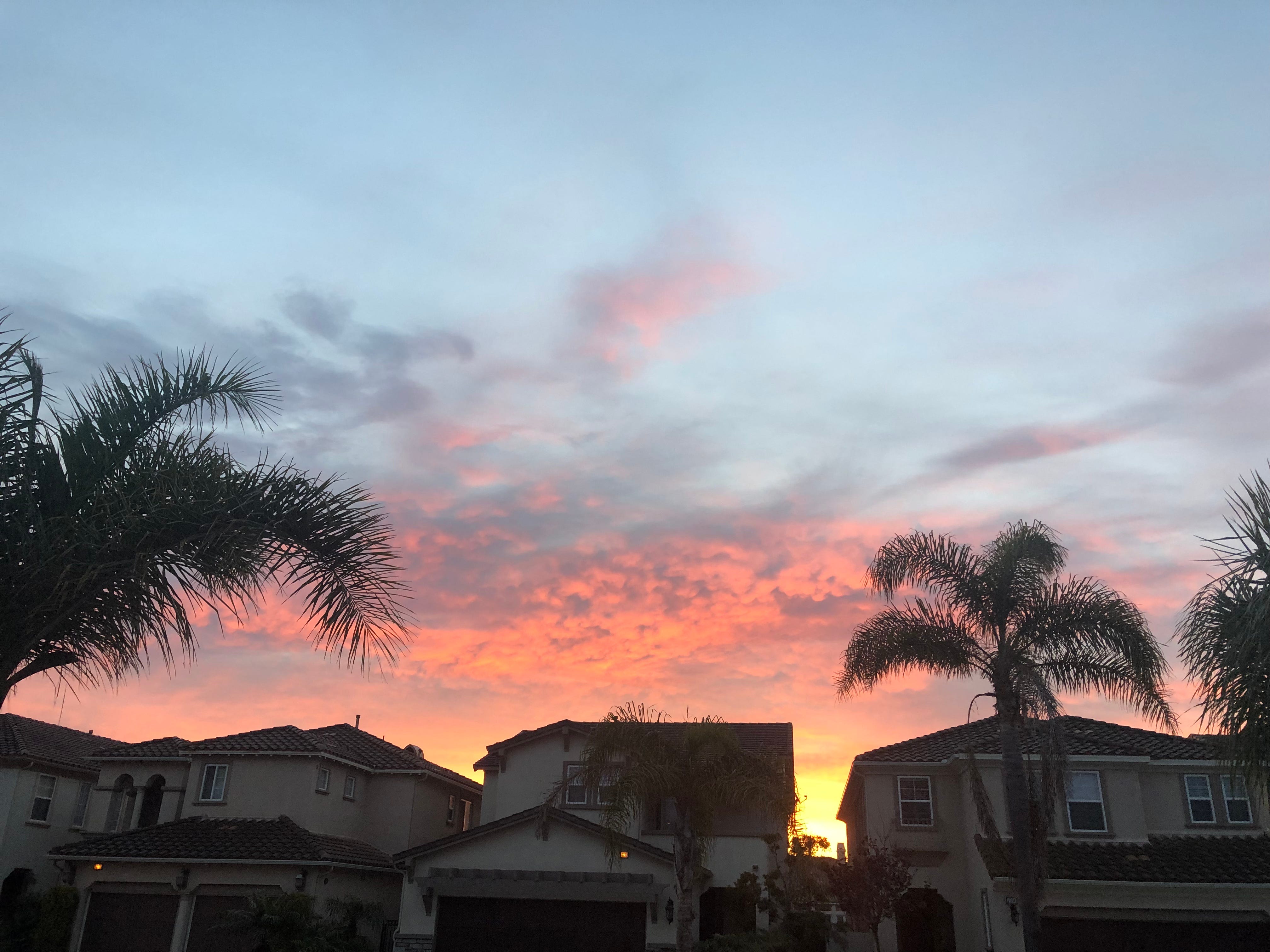
You’ve probably heard the rhyme. "Red sky at night, shepherd’s delight; pink sky in the morning, shepherd’s warning." It sounds like something your grandma says to avoid a picnic, but there is actually some hardcore physics behind it. It isn't just folklore. It’s basically a low-tech weather satellite system from the 19th century.
Yesterday, I woke up to a horizon that looked like someone had spilled a giant bottle of strawberry syrup across the clouds. It was stunning. But honestly, within four hours, I was scrambling to find an umbrella.
The Science of Scattering and Why the Sky Changes Color
To understand why a pink sky in the morning matters, we have to talk about Rayleigh scattering. This is the fancy term for what happens when sunlight hits our atmosphere. Sunlight is actually a mix of all the colors of the rainbow. When that light hits gas molecules and tiny particles in the air, it scatters.
Blue light has shorter wavelengths. It gets scattered more easily, which is why the sky looks blue during the middle of the day. But at sunrise and sunset? The sun is lower on the horizon. The light has to travel through a much thicker layer of the atmosphere to reach your eyes. By the time it gets to you, the blues and violets have been filtered out. Only the long wavelengths—the reds, oranges, and pinks—make it through.
But here is the kicker: you need stuff in the air to reflect that light back at you. If the sky is perfectly clear, you get a boring sunrise. To get that deep, glowing pink, you need clouds. Specifically, you need high-level clouds that can catch those long red wavelengths before the sun fully clears the horizon.
The "Shepherd's Warning" Explained
Why does a pink sky in the morning specifically signal bad weather? It comes down to how weather systems move. In the mid-latitudes (like North America and Europe), weather almost always moves from west to east.
When you see a vibrant pink sunrise in the east, it means the sun is shining through clear air to the east and hitting clouds that are currently sitting to your west. Since the sun rises in the east, it’s basically "backlighting" the storm clouds that are headed straight for you.
- Morning Pink: Clear skies in the east (where the sun is) + clouds in the west (where the weather is coming from).
- Evening Pink: Clear skies in the west (where the sun is setting) + clouds in the east (meaning the storm has already passed you).
It’s a simple game of geometry.
Is the Proverb Always Accurate?
Well, mostly. But let’s be real—it’s not 100%. Meteorologists like Jeff Habinsky have noted that while the proverb holds water in the mid-latitudes, it falls apart in the tropics. Near the equator, trade winds often blow from east to west. In that case, a pink sky in the morning might actually mean the weather is moving away from you.
Also, it depends on what is in the air. High pressure usually traps dust and small particles. This "junk" in the air helps scatter the light even more. If there's a high-pressure system to your east (clear morning) but a low-pressure system (moisture and clouds) moving in from the west, you get that classic warning glow.
How to Tell if it's Actually a "Warning" Sky
Not every colorful sunrise means a hurricane is coming. Sometimes it’s just pollution. Or a forest fire five hundred miles away. I remember back in 2023 when the Canadian wildfires sent smoke down into the U.S. East Coast; the sunrises were an eerie, neon pink for days. That wasn't a "storm" warning in the traditional sense, but it was definitely an atmospheric warning.
Look at the cloud types. If you see "mare's tails" (cirrus clouds) or "mackerel scales" (altocumulus clouds) glowing pink, those are the ones that usually precede a front. If it's just a hazy, dusty glow, you might just be looking at high particulate matter.
Why We Care About the Color Pink Specifically
People often use "red" and "pink" interchangeably in this context. Usually, the "pink" comes from light reflecting off higher-altitude ice crystals. Redder hues often mean the light is hitting lower-altitude water droplets or heavier dust. Both are signals of atmospheric moisture.
According to NOAA, the intensity of the color can actually tell you about the moisture content. A deep, dark red often suggests a lot of water vapor—meaning that rain isn't just "coming," it's basically already here. A lighter, dustier pink might just mean a change in wind direction or a minor pressure shift.
Historical and Cultural Roots
This isn't just some old wives' tale. It's actually in the Bible. In the Gospel of Matthew, Jesus says to the Pharisees, "When it is evening, ye say, It will be fair weather: for the sky is red. And in the morning, It will be foul weather to day: for the sky is red and lowring."
Think about that. Two thousand years ago, people were using the exact same visual cues to plan their day. Sailors throughout the centuries relied on this because, frankly, they didn't have much else. If you were on a boat in the middle of the Atlantic in 1750, a pink sky in the morning was your only signal to batten down the hatches.
Using Your Eyes Like a Meteorologist
Next time you see a pink sky in the morning, don't just take a photo for Instagram and go back to sleep. Look at the wind.
If the sky is pink and you feel a breeze coming from the south or southwest, that’s a very strong indicator that a warm front is approaching. Warm fronts bring steady, soaking rain. If the sky is pink but the air is totally still, the system might be moving slower than you think.
What Most People Get Wrong
People often think any "pretty" sunrise is a red sky warning. It’s not. If the entire sky is red, you’re already in the middle of it. The "warning" sky is specifically when the eastern horizon is clear enough to let light through, but the overhead or western sky is filled with high-altitude clouds.
If it’s cloudy everywhere, you won’t see the pink at all because the sunlight can’t get through the "thick" stuff to reflect off the "thin" stuff.
Actionable Steps for Sky Watchers
Don't just stare at the clouds; use the information. If you spot a pink sky in the morning, here is how to verify if you’re about to get soaked:
- Check the Barometer: if you have a weather station or even a smartphone app with a barometer sensor, look for a drop in pressure. A falling barometer plus a pink sunrise is a nearly certain sign of rain.
- Observe Cloud Movement: Look at the high-altitude clouds. Are they moving quickly from west to east? If they are "racing" the sun, the weather will likely turn within 6 to 12 hours.
- Look for "Sundogs": If you see bright spots on either side of the sun along with the pink hue, those are ice crystals. They almost always signal a change in the weather.
- Plan Your Day Accordingly: If you’re planning on painting the house or going on a long hike, maybe keep a "Plan B" ready. The shepherds weren't wrong; they were just observing physics before we had a name for it.
The pink sky is a gift of beauty, but it's also a functional tool. Treat it like a natural notification on your phone. It’s the atmosphere's way of telling you that the physics of the planet are shifting, and you might want to bring your laundry inside.
Check your local radar about two hours after a pink sunrise. You’ll often see the leading edge of a rain band starting to appear on the western edge of the map. It’s a fun way to realize just how connected we are to these global patterns.