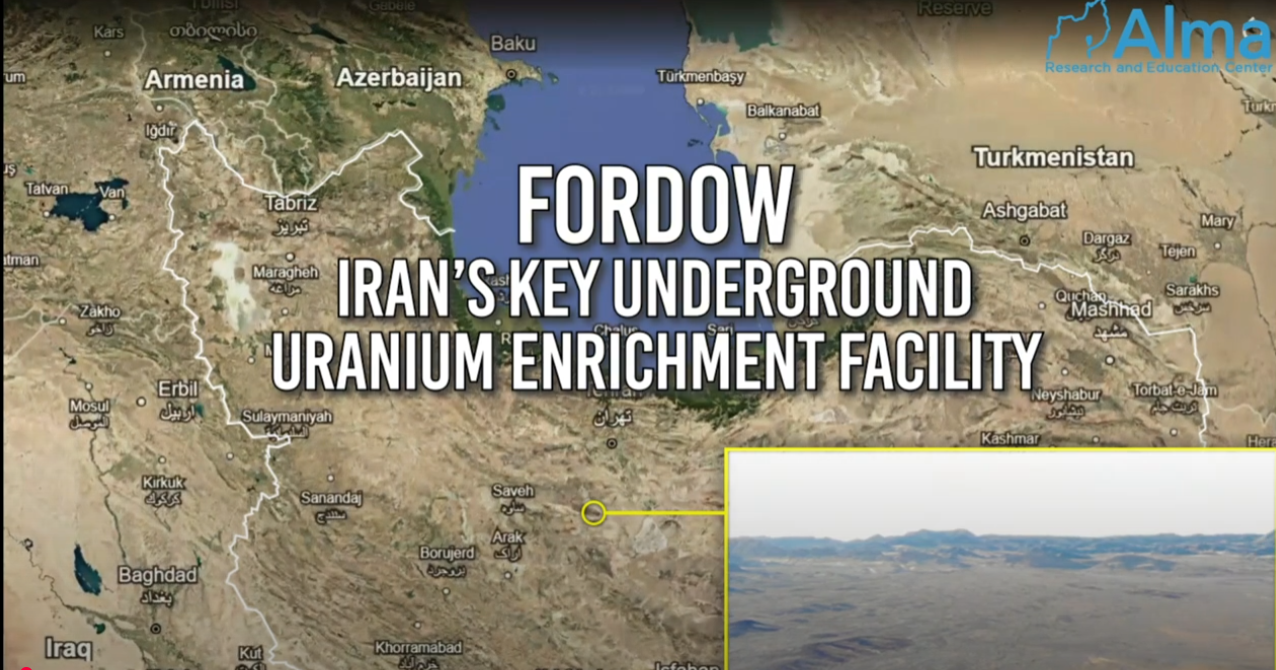
Deep inside a mountain near the holy city of Qom, there is a hole. Actually, it's more like a massive, hardened bunker carved into the rock, designed to survive a direct hit from the world’s most powerful bunker-buster bombs. This is the Qom uranium enrichment facility, officially known as the Fordow Fuel Enrichment Plant (FFEP). If you've followed the news over the last decade, you've heard the name. It sounds ominous. For many in the West, it’s the "smoking gun" of Iran's nuclear ambitions. But why? Why did they build it there, and what is actually going on behind those reinforced blast doors today?
The story of Fordow isn't just about centrifuges and isotopes. It’s a story of secrecy, satellite imagery, and a high-stakes game of cat-and-mouse between Tehran and the International Atomic Energy Agency (IAEA).
How the Secret Came Out
It was 2009. President Barack Obama, alongside leaders from France and the UK, stood before the cameras at the G20 summit in Pittsburgh. They dropped a bombshell. They revealed that Western intelligence had been tracking a secret underground site near Qom for years. Iran had been caught. Or, at least, that’s how the West framed it. Iran’s response? They basically said they weren't "hiding" it, they were just protecting it. They argued that because of constant threats from Israel and the U.S., they had to build a facility that couldn't be easily vaporized from the air.
That’s the core tension.
The site is located on a former Islamic Revolutionary Guard Corps (IRGC) base. It’s tiny compared to the massive Natanz facility, but it’s much harder to reach. While Natanz is a sprawling complex, Fordow is a fortress. It was designed to hold about 3,000 centrifuges. That’s not enough to run a massive civilian power program, which is exactly why the U.S. and its allies got nervous. If you have a small, highly protected site, it looks a lot more like a facility meant to produce highly enriched uranium (HEU) for a weapon than a place making fuel for a light-water reactor.
The Engineering of a Mountain Bunker
You have to imagine the scale of the earth above these machines. We are talking about roughly 60 to 80 meters of rock. This isn't just a basement. It's a subterranean labyrinth.
Inside, the Qom uranium enrichment facility houses cascades of centrifuges. These are tall, slender tubes that spin at incredible speeds—faster than the speed of sound. They use centrifugal force to separate the lighter $U-235$ isotopes from the heavier $U-238$. This process is the "enrichment" everyone talks about. Most nuclear power plants need uranium enriched to about $3.5%$. Research reactors, like the one in Tehran that produces medical isotopes, need about $20%$. Weapons? You’re looking at $90%$ or more.
The machinery used here has evolved. Originally, it was the IR-1, based on an old Dutch design stolen by A.Q. Khan. They were prone to breaking. Honestly, they were kind of junk. But over the years, Iran has replaced many of them with IR-6 centrifuges. These are much more efficient. They can enrich uranium much faster, which significantly shrinks the "breakout time"—the theoretical window Iran would need to produce enough material for a bomb if they decided to do so.
The JCPOA Rollercoaster
In 2015, everything changed. The Joint Comprehensive Plan of Action (JCPOA) was signed. Under that deal, Fordow was supposed to stop enriching uranium entirely. It was meant to become a "nuclear, physics, and technology center." No fissile material was allowed on site. The world breathed a sigh of relief.
Then 2018 happened. The U.S. pulled out of the deal.
By 2019, Iran started feeding uranium hexafluoride gas back into the centrifuges at the Qom uranium enrichment facility. They didn't do it in secret this time; they did it with the IAEA watching, as a way to pressure Europe and the U.S. to return to the deal. Since then, the levels of enrichment have crept up. First $5%$, then $20%$. In late 2022, the IAEA confirmed that Iran had begun producing uranium enriched to $60%$ at Fordow. That was a massive jump. While $60%$ isn't "weapons-grade," it's a very short technical step away from $90%$.
What People Get Wrong About Fordow
Most people think "enrichment" is a binary switch. You either have a bomb or you don't. It's not like that. It's a gradient of technical capability.
One common misconception is that the site is strictly for military use. Iran maintains that the $20%$ enrichment is for the Tehran Research Reactor to treat cancer patients. While that’s a legitimate use for that specific level of uranium, the sheer volume of enriched material being produced at such a fortified site is what keeps intelligence agencies awake at night.
Another thing: the site isn't invincible. While it's deep, the U.S. developed the GBU-57A/B Massive Ordnance Penetrator (MOP) specifically for sites like this. It’s a 30,000-pound beast of a bomb. So, while it's "protected," it's not a magic shield. It just makes an attack much, much harder and more complicated.
The "83.7%" Incident
In early 2023, something weird happened. The IAEA inspectors found traces of uranium particles enriched to $83.7%$ at Fordow. That’s basically weapons-grade. It caused a global panic.
Was Iran secretly "going for it"?
Iran’s explanation was that it was an "unintended fluctuation." Basically, when you're starting up or adjusting a cascade of centrifuges, the levels can spike momentarily. Think of it like a car engine revving too high for a second when you shift gears. The IAEA eventually accepted this explanation but increased the frequency of inspections. This shows just how twitchy the international community is regarding the Qom uranium enrichment facility. Every microscopic particle is analyzed. Every seal on every door is checked.
The Current State of Play
As of 2026, the situation at Fordow is... tense. The facility is more active than it has been in years.
- Infrastructure Expansion: Satellite imagery has shown new construction around the site. They are digging more tunnels, likely for support services or to further harden the electrical and cooling systems.
- Advanced Centrifuges: The old IR-1s are being phased out. The IR-6 is the new workhorse. This means the site can produce more enriched uranium with a smaller footprint.
- IAEA Access: This is the big one. Access fluctuates. Sometimes the inspectors are allowed in daily; sometimes Iran restricts their visas or turns off the surveillance cameras to protest sanctions.
Without the cameras, we are essentially flying blind. We know the machines are spinning, but we don't always know exactly what is going into the pipes or what is coming out of them.
Why This Matters to You
You might think, "I'm thousands of miles away, why do I care about a hole in a mountain in Iran?"
It’s about the global oil market and the risk of a regional war. If Israel or the U.S. decides that the Qom uranium enrichment facility has crossed a "red line," an airstrike becomes a real possibility. An attack on Fordow would likely lead to a closure of the Strait of Hormuz. If that happens, gas prices don't just go up—they skyrocket. Your cost of living is directly tied to the stability of the Middle East, and Fordow is currently the most volatile variable in that equation.
Furthermore, there's the risk of nuclear proliferation. If Iran achieves a weapon, Saudi Arabia has hinted they might want one too. Then Turkey. Then Egypt. It’s a domino effect that makes the world a much more dangerous place.
The Realities of Nuclear Diplomacy
The problem with Fordow is that it can't be "un-built." The knowledge of how to build these centrifuges and how to run them is already there. You can't bomb knowledge. Even if the site were leveled tomorrow, the engineers and the data would remain.
This is why diplomacy is so frustrating and so necessary.
The Qom uranium enrichment facility serves as Iran's ultimate leverage. They know it’s a sore spot for the West. They use it as a bargaining chip to try and get sanctions lifted. It’s a high-stakes game of chicken where the "car" is a nuclear-capable bunker and the "road" is the global economy.
Identifying Truth from Propaganda
When reading about Fordow, you have to be careful. Iranian state media will tell you it's a purely peaceful site for scientific advancement. Some Western hawks will tell you it’s a "bomb factory" that’s ready to produce a warhead tomorrow.
The truth is somewhere in the middle. It is a facility with clear military potential that is currently being used for high-level enrichment that could be diverted to a weapons program very quickly. It is not a bomb yet, but it is the infrastructure for one.
Actionable Insights and Next Steps
If you want to stay informed on this without falling for the "clickbait" cycles, here is how to track the situation like a pro:
- Monitor IAEA Reports: Don't wait for the news to summarize them. The IAEA publishes quarterly reports on Iran's nuclear program. Look for the sections specifically mentioning the "Fordow Fuel Enrichment Plant." Look at the "enriched stockpile" numbers.
- Watch the "Breakout Time": Think tanks like the Institute for Science and International Security (ISIS) frequently calculate how long it would take Iran to produce enough $90%$ uranium for one weapon based on the centrifuge counts at Fordow and Natanz. If that number drops below two weeks, expect the geopolitical rhetoric to hit fever pitch.
- Check Open-Source Intelligence (OSINT): Follow accounts that analyze satellite imagery. Changes in the "spoil piles" (the dirt dug out of the mountain) at the Qom uranium enrichment facility are often the first sign of a new expansion.
- Follow the Diplomacy: The "P5+1" (the permanent members of the UN Security Council plus Germany) are the ones negotiating. If talks in Vienna or Geneva stall, the activity at Fordow usually increases as a response.
The facility at Qom remains one of the most guarded and controversial spots on the planet. It’s a feat of engineering, a symbol of defiance, and a potential flashpoint for a global crisis. Understanding what it is—and isn't—is the first step in making sense of the complex geopolitical landscape of 2026.