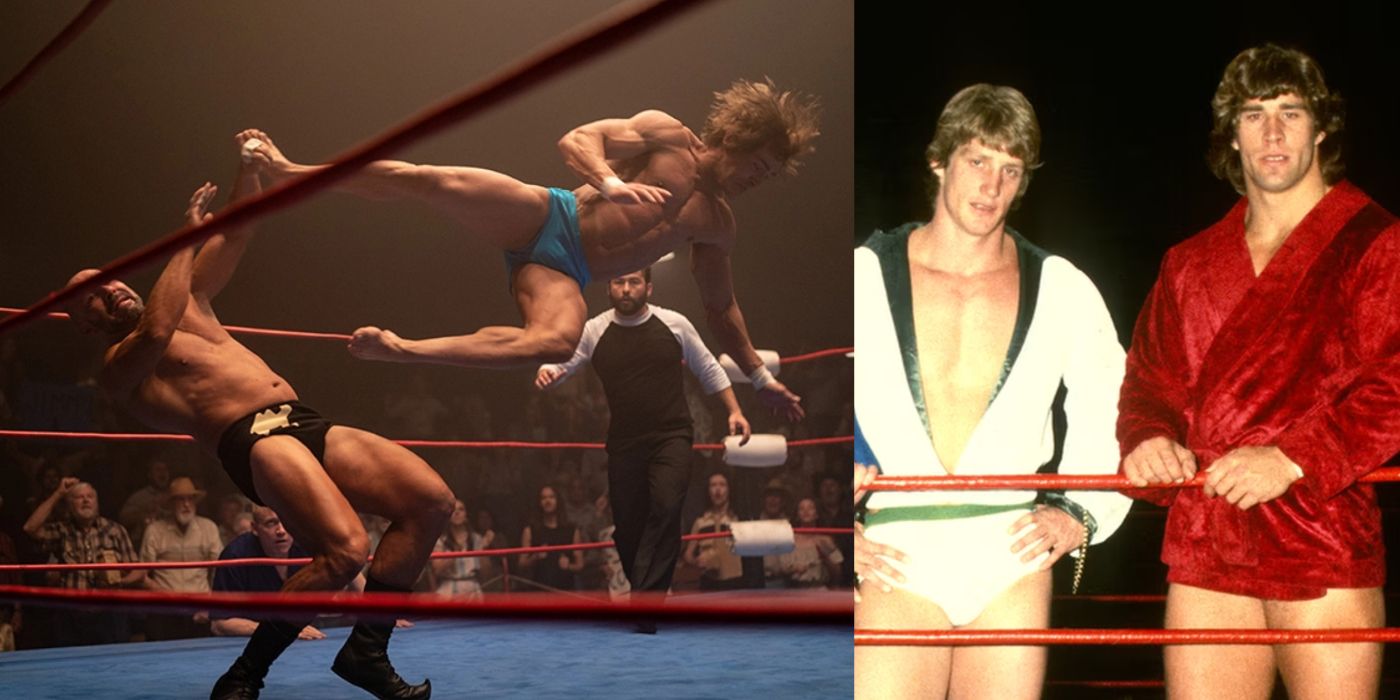
You’ve probably seen the posters. Zac Efron looks like he’s been carved out of granite, his muscles so intense they almost look fake. But the story behind the Von Erich family movie, officially titled The Iron Claw, is anything but plastic. It’s heavy. It’s the kind of story that makes you wonder how much a single family can actually take before they just… break.
Most people going into the theater expect a standard sports biopic. You know the drill: the underdog wins, the music swells, everyone goes home feeling inspired. This isn't that. It’s a tragedy wrapped in spandex and neon lights.
The Von Erichs weren't just wrestlers. They were gods in Texas. Back in the early 80s, if you lived in Dallas, the Dallas Cowboys were big, but the Von Erichs were arguably bigger. They sold out the Sportatorium and Reunion Arena like it was nothing. But behind the scenes, a "curse" was tearing the family apart, one brother at a time. Honestly, the movie had to leave parts out because the real reality was actually too depressing for a two-hour runtime.
The Fritz Von Erich Influence and the Real World Class Era
To understand why the Von Erich family movie feels so claustrophobic, you have to look at the patriarch, Fritz Von Erich. Born Jack Adkisson, Fritz was a top-tier heel in his day, famous for "The Iron Claw" grip. He was a man who believed in a very specific, very rigid version of masculinity. To Fritz, his sons weren't just children; they were extensions of his own legacy and his business, World Class Championship Wrestling (WCCW).
It’s easy to paint Fritz as a pure villain. The film, directed by Sean Durkin, leans into that "tough love" angle heavily. But in real life, the nuances were weirder. Fritz was a marketing genius. He pioneered the use of rock music for entrances and high-production value for televised wrestling. He turned his sons—Kevin, David, Kerry, Mike, and Chris—into rock stars.
- Kevin Von Erich: The eldest survivor and the heart of the family. He wrestled barefoot, a choice that became his trademark.
- David Von Erich: Often called the "Yellow Rose of Texas," he was the one everyone thought would be the NWA World Champion.
- Kerry Von Erich: "The Modern Day Warrior." He had the look of a literal Greek god and actually reached the mountaintop, winning the world title from Ric Flair.
- Mike and Chris: The younger brothers who, frankly, never should have been in the ring.
The pressure was immense. You weren't just competing against other wrestlers; you were competing for your father’s approval. And in that house, second place was basically the same as being invisible.
Why Chris Von Erich Was Cut From the Movie
One of the biggest controversies among hardcore wrestling fans regarding the Von Erich family movie is the total absence of Chris Von Erich. Chris was the youngest brother. He was smaller than the others, plagued by asthma and brittle bones, but he desperately wanted to be just like his idols—his older brothers.
Sean Durkin has gone on record saying that including Chris simply made the movie too long and too repetitive in its tragedy. Think about that. The reality was so devastating that a Hollywood screenwriter had to remove a person’s entire life to make the story digestible. Chris took his own life in 1991, following the deaths of David, Mike, and the suicide of Kerry later in 1993.
By omitting Chris, the film focuses more on the brotherhood between Kevin, David, and Kerry. But it leaves a gap for those who know the history. Chris represented the most heartbreaking part of the Von Erich saga: the desperate need to belong to a legacy that was actively killing your family.
The Mystery of David Von Erich in Japan
In the Von Erich family movie, David’s death is a pivot point. It’s the moment the "curse" feels real. David died in a hotel room in Japan in 1984. The official cause was enteritis—a ruptured intestine. However, the wrestling world has buzzed with rumors for decades.
Ric Flair, in his autobiography To Be the Man, suggested that David’s death might have involved a drug overdose and that fellow wrestler Bruiser Brody disposed of the evidence to protect the family’s image. Kevin Von Erich has vehemently denied this for years. He maintains it was a medical issue, plain and simple.
This is where the movie gets the tone right even if the medical specifics are brief. The shock of David’s death wasn't just personal; it was a business catastrophe. WCCW was built around David’s impending championship run. When he died, Fritz did something controversial: he turned David’s death into a promotional tool. The "David Von Erich Memorial Parade of Champions" became a massive event. It’s a grim look at how the line between family and "the business" was totally blurred.
Kerry Von Erich: The Secret He Kept from the World
Zac Efron’s transformation is incredible, but Jeremy Allen White’s portrayal of Kerry Von Erich is arguably the soul of the film. Kerry was the star. He had the "it" factor. But he was also living a lie for a significant portion of his career.
In 1986, Kerry was involved in a horrific motorcycle accident. He returned to the ring and even won the WWF Intercontinental Championship as "The Texas Tornado." What most fans didn't know until much later was that Kerry was wrestling on a prosthetic foot. He had lost his right foot in that accident.
Imagine the physical and mental toll. Wrestling is a grueling, high-impact sport. Kerry was doing it with a stump shoved into a boot, terrified that if anyone found out, his career would be over. The Von Erich family movie handles this with a sort of quiet dread. It fueled his addiction to painkillers, a struggle that eventually led to his suicide at his father’s ranch. He was only 32.
The "Curse" vs. Toxic Masculinity
People love to talk about the Von Erich curse. It sounds mystical. It sounds like something out of a Greek tragedy where the gods are punishing a family for their hubris. But if you look at the facts presented in the Von Erich family movie, the "curse" looks a lot more like a combination of undiagnosed mental health issues, extreme pressure, and a lack of support systems.
Fritz Adkisson grew up in an era where you didn't talk about feelings. You didn't admit you were hurting. You "toughed it out." When Mike Von Erich suffered a shoulder injury that led to Toxic Shock Syndrome and brain damage, he was pushed back into the ring far too soon. He wasn't the same. He knew he couldn't live up to the "Von Erich" name anymore.
Kevin Von Erich, the last brother standing, has often said he doesn't believe in a curse. He believes in bad luck and bad choices. His perspective is what grounds the movie. He chose to walk away. He chose to prioritize his own family—his wife and children—over the crumbling empire of WCCW.
Accuracy Check: Movie vs. Reality
While The Iron Claw is a masterpiece of tone, it takes liberties. That’s Hollywood.
- The Timeline: The movie condenses about a decade of tragedy into what feels like a few years. In reality, the deaths were spread out from 1984 to 1993.
- The Brother Count: As mentioned, Chris is gone. Mike is also somewhat sidelined in the narrative compared to the "big three."
- The Wrestling: The movie captures the look of the Sportatorium perfectly. The lighting, the smoke, the grit—it’s spot on. The actors did their own stunts, and you can feel the impact.
- The "Iron Claw" itself: The way the film depicts the physical toll of the move and the training is incredibly accurate to the reports of wrestlers who trained under Fritz.
What You Can Learn from the Von Erich Story
If you’re looking for a takeaway from the Von Erich family movie, it’s not about wrestling. It’s about the danger of living for someone else’s dream. The brothers were trapped in a cycle of performance.
- Define your own success. The Von Erich boys were trying to win a game where the rules were set by a man who couldn't be satisfied.
- Physical health is mental health. The sheer volume of painkillers and steroids in the wrestling industry during that era was a ticking time bomb.
- Legacy isn't worth your life. Kevin Von Erich is the "winner" of the story not because he won titles, but because he survived. He moved to Hawaii, started a new life, and broke the cycle.
How to Explore the History Further
If the movie left you wanting more context, there are better places to look than a standard Wikipedia page.
First, watch the 30 for 30 documentary called The Triumph and Tragedy of World Class Championship Wrestling. It features real footage of the brothers and interviews with the people who were actually there. It provides the "E-E-A-T" (Experience, Expertise, Authoritativeness, and Trustworthiness) that a dramatized movie sometimes skips.
Second, look up Kevin Von Erich’s recent interviews. He’s been very vocal about his thoughts on the film. He praised Zac Efron’s performance but noted that his father, Fritz, wasn't quite the monster he appears to be on screen—or at least, it was more complicated than that.
The Von Erich family movie serves as a gateway. It’s a beautiful, harrowing look at a family that had everything and lost almost all of it. But the real story is in the survival of Kevin and the lessons we can draw from the wreckage of WCCW.
Practical Next Steps for Fans:
- Check out the "Dark Side of the Ring" episode on the Von Erichs for a more "unfiltered" and gritty look at the drug use and business failures.
- Compare the movie's choreography to actual WCCW footage on YouTube; you'll see how closely Efron and White mimicked the brothers' specific "brawling" styles.
- Read "The Von Erich Myth" articles from long-time wrestling journalists like Dave Meltzer to understand the regional impact they had on the NWA.