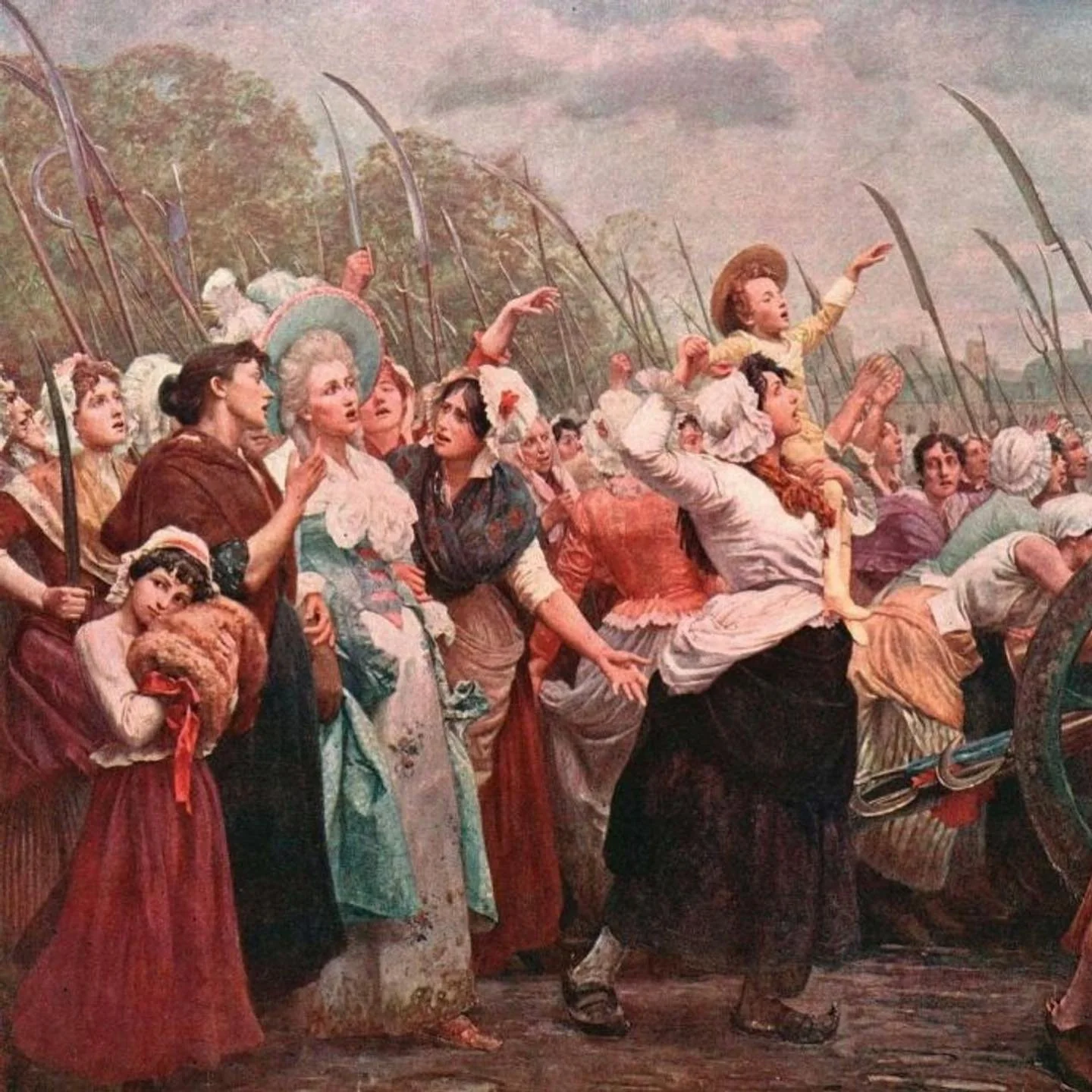
It started with bread. Or rather, the total lack of it. Imagine waking up in 1789 Paris, your kids are crying because they haven't eaten in two days, and you find out the local baker has nothing left. You're exhausted. You're angry. Then you hear a rumor that the King and his court at Versailles are throwing lavish banquets, literally trampling on the tricolor cockade of the revolution.
That’s how The Women's March to Versailles began. It wasn't some high-level political strategy sessions in a mahogany room. It was a bunch of fed-up market women, the poissardes (fishwives), who decided they’d had enough. They grabbed kitchen knives, pikes, and whatever else was lying around. They beat drums. They marched.
The Day Paris Walked to the Palace
On the morning of October 5, 1789, a young woman started beating a drum in the markets of east Paris. That’s all it took. Within hours, thousands of women gathered at the Hôtel de Ville, demanding bread and arms. When the city officials couldn't give them what they wanted, the crowd—now numbering around 7,000—started the six-hour trek to Versailles in the pouring rain.
Honestly, it’s hard to overstate how miserable this march was. It was muddy. It was cold. But these women were driven by a very specific kind of rage that only comes from watching your family starve while the ruling class lives in a bubble. By the time they reached the palace, they were soaked to the bone and ready for a fight.
The King, Louis XVI, was caught off guard. He was out hunting when the news reached him. Typical. He didn’t understand that this wasn't just another riot he could wait out. This was a fundamental shift in power. For the first time, the "ordinary" people weren't just asking for change; they were coming to the doorstep of the monarchy to take it.
Why the Women's March to Versailles Still Matters
Most history books focus on the Fall of the Bastille. Sure, the Bastille was symbolic, but the Women's March to Versailles was practical. It stripped the monarchy of its physical distance from the people. Before this, the King lived in a dream world at Versailles, miles away from the filth and hunger of Paris. After this? He was a prisoner of the people in the Tuileries Palace.
The Fishwives of the Revolution
The poissardes were legendary. These weren't delicate Victorian ladies. These were women who hauled heavy crates of fish every day, possessed incredible physical strength, and had a vocabulary that would make a sailor blush. They were the backbone of the Parisian working class. When they showed up at the National Assembly, they didn't just sit in the gallery; they shouted down the speakers, demanded to be heard, and basically took over the room.
They forced their way into the palace. It got violent. Several bodyguards were killed, and their heads were put on pikes. It's a grisly detail, but it shows how high the stakes were. This wasn't a polite protest. This was a desperate struggle for survival.
The King’s Fatal Hesitation
Louis XVI had a chance to de-escalate. He met with a small delegation of women and promised to release bread from the royal stores. For a moment, it seemed like the crowd might go home. But the mood shifted. There was deep-seated distrust. People didn't believe his promises anymore.
When the Marquis de Lafayette arrived with the National Guard, he tried to keep the peace, but the momentum was unstoppable. The crowd demanded the King return to Paris. They wanted to see him, to monitor him, and to ensure he couldn't plot a counter-revolution from the safety of his country estate.
Misconceptions About the March
You've probably heard that the French Revolution was led by intellectuals like Robespierre or Danton. While they certainly shaped the philosophy, the Women's March to Versailles proves that the muscle—the actual forward motion—often came from the bottom up.
Another big myth: it was just about food.
While hunger was the spark, the demands were deeply political. They wanted the King to sanction the "Declaration of the Rights of Man and of the Citizen." They were fighting for a constitutional monarchy, even if they didn't all use those exact words. They knew that as long as the King stayed at Versailles, he was surrounded by conservative advisors who wanted to crush the new National Assembly.
- The march wasn't purely spontaneous; activists had been talking about moving the King to Paris for weeks.
- Men were involved, too. Many dressed as women to avoid being targeted by royal troops, but the leadership and the majority of the crowd were female.
- It wasn't just "the poor." Some members of the middle class joined in, recognizing that the economic collapse affected everyone.
The Moment Everything Changed
At dawn on October 6, the crowd broke into the palace. They were looking for Marie Antoinette. The Queen was the ultimate villain in the eyes of the public—the "Austrian woman" who supposedly didn't care if they lived or died. She narrowly escaped through a secret passage to the King's apartments.
Eventually, Lafayette convinced the King to appear on the balcony. The crowd's reaction was a weird mix of traditional loyalty and revolutionary fervor. They shouted "Vive le Roi!" (Long live the King) but also "Le Roi à Paris!" (The King to Paris).
The King gave in.
The procession back to Paris was surreal. It took hours. The King and Queen were in their carriage, surrounded by thousands of people carrying loaves of bread on pikes and singing that they were bringing back "the baker, the baker's wife, and the baker's little boy."
Actionable Takeaways from the March
Studying the Women's March to Versailles isn't just about memorizing dates for a history quiz. It offers real insights into how social change actually happens.
- Proximity is Power: The march succeeded because it removed the physical barrier between the rulers and the ruled. In modern activism, this translates to making the consequences of policy visible to those making the decisions.
- Economic Triggers: Most revolutions aren't sparked by high-concept ideas; they are sparked by the inability to meet basic needs. When the cost of living becomes unbearable, social stability evaporates.
- The Power of the Outsider: The poissardes were marginalized even within the revolutionary movement. Yet, they were the ones who forced the King's hand when the politicians were stuck in a stalemate.
If you want to understand the French Revolution, stop looking at the portraits of generals. Look at the rainy road between Paris and Versailles. Look at the women who decided that if the government wouldn't feed their children, the government no longer had the right to hide in a palace.
To dig deeper into this era, your next steps should be exploring the primary sources from the National Assembly during October 1789. Specifically, look for the "October Days" testimonies which provide firsthand accounts of the chaos inside the palace walls. You can also visit the Carnavalet Museum's digital archives to see the original engravings of the market women, which capture the raw intensity of the march better than any modern recreation.