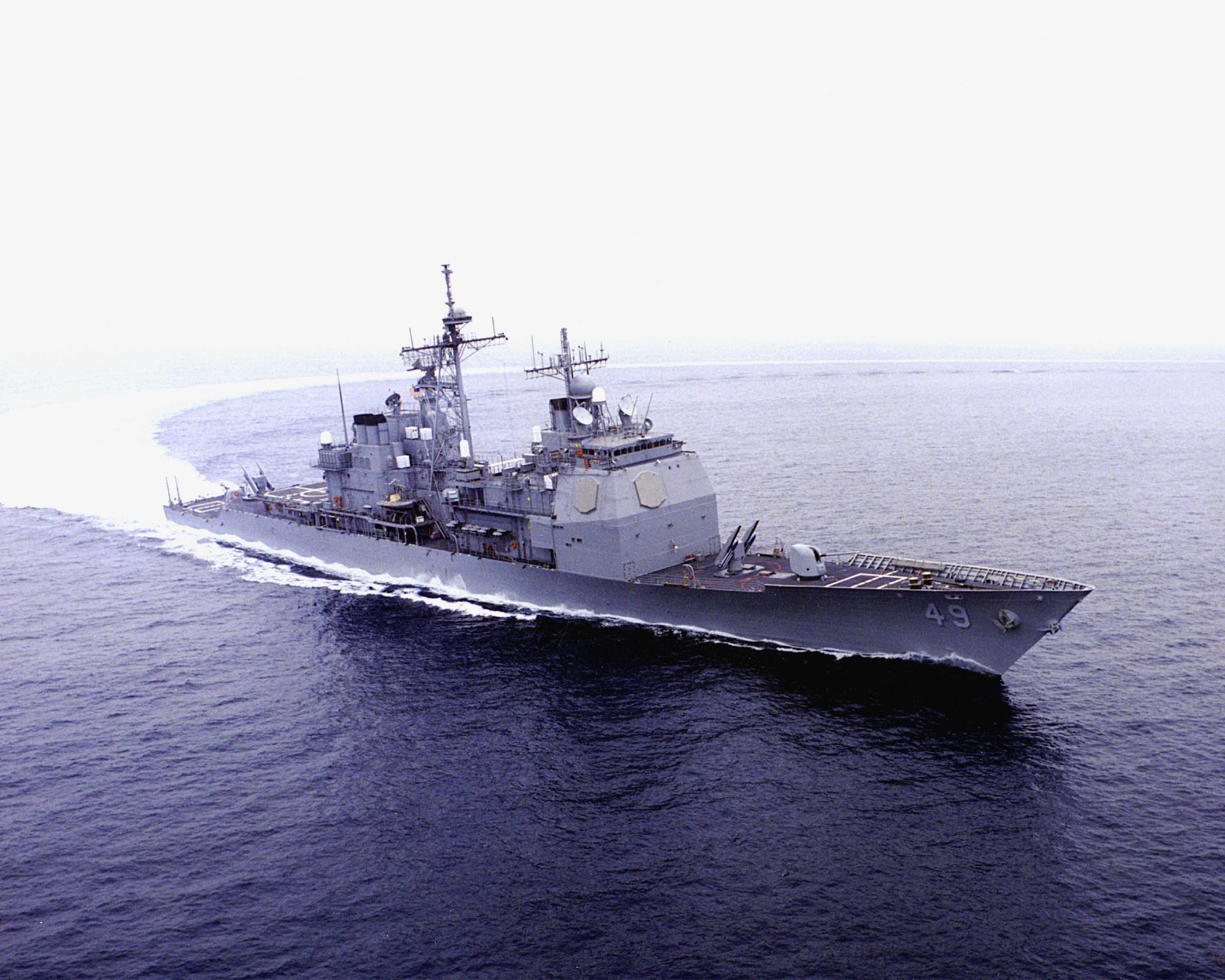
The ocean has a way of swallowing iron and steel, but it can’t seem to bury the ghost of the USS Vincennes CG 49. If you walk through a naval museum or scroll through military forums today, the name still sparks a specific kind of tension. It isn't just about a ship. It is about a moment in 1988 when high-tech sensors, human panic, and the heat of the Persian Gulf collided with devastating results.
She was a Ticonderoga-class guided-missile cruiser. A billion-dollar beast. At the time, she was the "Robocruiser," the peak of American naval engineering, sporting the then-revolutionary Aegis Combat System. People thought she was invincible. They thought the computer couldn't be wrong. They were wrong.
The Aegis System and the Tech Behind USS Vincennes CG 49
Technically, the USS Vincennes CG 49 was a marvel. Built by Ingalls Shipbuilding and commissioned in 1985, she featured the SPY-1 radar, which could track hundreds of targets simultaneously. It was designed to protect carrier battle groups from swarms of Soviet missiles. But in the late 80s, the mission shifted to the "Tanker War" between Iran and Iraq.
The ship was basically a floating computer. The Aegis system utilized the AN/SPY-1 phased-array radar to create a 360-degree picture of the sky. In the windowless Combat Information Center (CIC), sailors sat in front of blue-lit screens, trusting the digital symbols to tell them what was real and what was a threat. This was the era of the "push-button war." However, the interface was clunky by modern standards. It didn't show a video of the plane. It showed a "track number" and a vector.
July 3, 1988: The Fog of Digital War
The heat in the Strait of Hormuz that morning was oppressive. The USS Vincennes CG 49 was already in a skirmish with Iranian speedboats. Adrenaline was high. When Iran Air Flight 655 took off from Bandar Abbas, it was a routine civilian flight to Dubai. But on the screens inside the Vincennes, the computer tagged it as "Track 4131."
Confusion reigned. One operator thought the plane was descending—a classic attack profile for an F-14 Tomcat. Another thought it was ascending. The Aegis system actually showed the plane was climbing (civilian behavior), but the human operators, under the stress of active surface combat, convinced themselves it was diving toward them. Captain Will Rogers III made the call. He authorized the launch of two SM-2MR surface-to-air missiles.
Both hit.
290 people died. Not soldiers. Families. Pilgrims. Children. The "Robocruiser" had performed its job perfectly, except it had targeted the wrong thing. This remains one of the most significant tragedies in naval history, and it forced the Navy to rethink how humans interact with complex AI and automated systems.
The Aftermath and the "Robocruiser" Reputation
You’d think the ship would be decommissioned immediately out of shame, but the Navy kept her in service for years. The USS Vincennes CG 49 continued to deploy, even earning awards for later missions. But the stigma never left. To the Iranian public, she was a symbol of American ruthlessness. To naval historians, she became a case study in "scenario fulfillment"—a psychological phenomenon where people see what they expect to see, regardless of the data on the screen.
Admiral William Crowe, then Chairman of the Joint Chiefs of Staff, initially defended the crew, stating they acted reasonably given the information they had. Later reports, including a 1992 investigation by Newsweek and Nightline, suggested the ship might have been in Iranian territorial waters at the time of the launch, contrary to initial Pentagon claims. This adds a layer of geopolitical messiness that still gets debated in International Law classes.
Life After the Tragedy
The ship eventually finished its service life in the Pacific. It was decommissioned in 2005 at Naval Station San Diego. For a ship that cost a fortune and represented the future of warfare, her end was quiet. She was towed to Bremerton and eventually scrapped in 2010.
- Commissioned: July 1985
- Decommissioned: June 2005
- Motto: "Liberty Through Vigilance" (a phrase that feels heavy in hindsight)
- Final Fate: Scrapped in Brownsville, Texas
What’s wild is that the Aegis system used today on Arleigh Burke-class destroyers is a direct descendant of the one on the Vincennes. The tragedy led to massive overhauls in user interface (UI) design. The Navy realized that "more data" isn't the same as "better decision-making." They had to make the screens more intuitive so a tired, terrified 22-year-old wouldn't mistake a wide-body Airbus for a fighter jet.
Lessons We Still Haven't Quite Learned
The USS Vincennes CG 49 story is more relevant now than ever. Why? Because we are moving toward autonomous weapons and AI-driven combat. The disaster in the Persian Gulf was a "human-in-the-loop" failure. The computer had the right data (the plane was ascending), but the humans overrode it because of their internal bias.
If you're researching this ship for a project or out of historical interest, look beyond the technical specs of the Mk 26 missile launchers or the gas turbine engines. Look at the Vincennes as a warning about the limits of technology. It’s a reminder that even the most advanced sensors can't see through the "fog of war" if the people behind the consoles aren't trained to handle the psychological pressure of a crisis.
How to Research the USS Vincennes Legacy
If you want to dig deeper into what happened with the USS Vincennes CG 49, start with the formal investigations but look for the outliers.
- Read the Fogarty Report: This is the official Navy investigation. It’s dense, but it shows exactly how the Navy justified the crew's actions.
- Compare International Accounts: Look at how the incident is taught in Iran compared to the US. The "Vincennes" is a household name there for all the wrong reasons.
- Study Human-Computer Interaction (HCI): This ship is a textbook case in engineering courses for how NOT to design a high-stakes interface.
- Visit the Memorials: There are no major physical monuments to the Vincennes in the US, but the victims of Flight 655 are memorialized in Iran, which keeps the diplomatic wound open even decades later.
The story of the USS Vincennes CG 49 isn't just about a boat. It's about the terrifying gap between what a machine knows and what a human believes. It’s a piece of history that should make anyone working with AI or high-tech military gear a little bit nervous. Honestly, that’s probably a good thing. Vigilance is one thing, but as the Vincennes proved, certainty can be a killer.
To truly understand the impact, you should look into the legal settlement from 1996, where the U.S. expressed "deep regret" and paid $131.8 million to settle the case brought by Iran at the International Court of Justice. Though the U.S. never formally apologized to the Iranian government, the payout was a tacit acknowledgment of the tragedy. Exploring the transcripts of the 1992 Congressional hearings on the incident provides even more nuance into the conflicting testimonies of the crew and the surrounding fleet.